


Cable Drum
Company Profile
Tianjin Wangxia Spring Co., Ltd. has been specializing in the production of springs for 20 years. It is a leading manufacturer of Garage door springs. 11 spring production lines to ensure delivery speed.At the same time, our factory also continues to develop new products.
Inquiry:The customer send me details inquiries with quantity to us.Special requirement need drawing or samples.
Quotation:We according to your inquiry with quantity give you the best price.
Negotiation:Change details and decide final order.
Contract:We according to customer's final order make contract and need customer to pay 30% deposit.
Mass Production:We will make as related standards or customer requirement for production.
Delivery:After passing the sampling inspection, inform customer to pay balance,then arrange for shipment.
Feedback:After the goods arrived the customer's hand,inquire about customer satisfaction.
Why Choose Us
Competitive Price
Our product offers the advantage of low production costs, ensuring competitive pricing for our customers.
High Quality
We are a rapidly growing company and supply all of garage door parts,spring,hinge,bracket,roller,bearing,track,angle,fitting,bumper,cable drum,shaft,handle and lock.
Fast Delivery
We prioritize swift delivery, ensuring orders reach our customers promptly.
Custom Service
OK will build long-term,reliable supplier,help you to deal any questions.

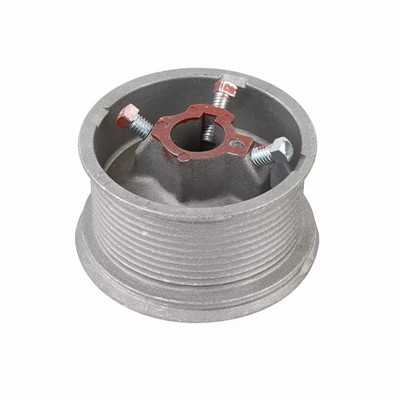


What is Cable Drum?
Cable drums are cylindrical shaped constructions which store, distribute and also retrieve cables or wires. Typically, the drum is electrically powered via a motor, so that the cables can wind or unwind as needed, such as along a specified track.
The components found in cable reeling drums include the drum (or spool), flanges, bearing system, cable entry/exit point, drive system and the brake system. These all work together to ensure the cable drum is able to safely store and retrieve cables as required.
The exact configuration of a cable drum can be built to your needs to suit the environment and usage application. Some of the options to choose from include spring operated cable reeling drums, along with motor or hose driven cable reels.
Benefits of Cable Drum
Reduced Physical Strain
Handling heavy cable drums manually poses serious risks to staff health and safety. Back injuries and muscle strain are two examples of the risks posed. The Cable Drum Trolley minimises physical strain providing a secure and ergonomic solution. For both moving and unwinding cable drums.
Enhanced Efficiency
The primary advantage of using a cable drum trolley is the significant improvement in efficiency. Traditional methods are time-consuming and labour-intensive. A Cable Drum Trolley, streamlines the process, allowing staff to work more efficiently.
Versatility
Not restricted by size and weight. You can configure the trolley to accommodate different drum sizes and weights. With a capacity of 5000kg, you can easily adapt this versatile equipment to meet a range of needs.
Cable Management
Equipped with a winding mechanism that allows for precise control when unwinding cables, this feature is particularly beneficial in applications where cable length accuracy is crucial. Moreover, it helps prevent tangling, kinking, and damage to cables during deployment.
Types of Cable Drum
Wooden cable drums
As its name implies, a wooden cable drum is a cable drum made of wood that is usually sourced from a sustainably managed forest in order to meet the ISPM-15 requirements. Wooden cable drums are utilised in a variety of telecommunication and industrial sectors since they are quite versatile and can be used either numerous times or in one-time use. Compared to other types of cable drums, those made of wood are also lighter in weight and relatively more affordable..
Plywood cable drums
Plywood cable drums are typically utilised as disposable packaging. Like wooden cable drums, plywood cable drums are relatively lightweight and simple, and they are best suited for optical fibre cables, installation cables, wires, and thinner plastic hoses. Essentially, the flanges of a plywood cable drum are made of plywood, while its core material can either be wood, board, aluminium, or plastic, depending solely on the intended application for the drum.
Plastic cable drums
Plastic cable drums are manufactured from different plastic materials. The choice of material is dependent on the drum’s intended use and the environment in which it will be utilised. The material also impacts both the price and the properties of the plastic cable drum. Usually, plastic cable drums are ideal for smaller applications and are used mainly for ropes or hawsers, textile bands, hoses, lines, cables, and wires. Most plastic drums nowadays are made of water PVC, which is easy to maintain and recyclable.
Steel cable drums
Steel cable drums are cable drums that are often built from high-quality metals in order to withstand harsh environments and heavy loads. Compared to wooden reels, steel cable drums are longer lasting but are also heavier and more expensive. Steel cable drums cover a wide range of applications where heavy loads are to be carried. They can be used to reel in ropes, wires, and electrical cables. Since they are durably constructed, they can be safely and neatly stored away.
Cable drum dispensers apply to a wide range of industries. Let’s cover the environments and sectors where they are commonly used.
Telecommunications: Telecom companies use cable drums to install, repair, and maintain coaxial cables, fibre optic cables, and other communication lines.
Transportation: A cable dispenser is used for wiring ships, vehicles, aircraft, and other forms of transportation.
Oil and gas: Wiring offshore platforms, pipelines, and drilling equipment is critical in this sector,
Agriculture: Infrastructure development projects such as roads, public buildings, and bridges use cable rollers to install communication, electrical, and security systems.
Renewable energy: Solar and wind power install cables in solar farms, wind turbines, and other renewable energy installations.
Mining: Workers are prone to safety hazards, so heavy-duty cables are used to power equipment and machinery and handle and deploy these cables.


Preparing the transport operation
Check the infrastructure: It is necessary to ensure that the port sites and other transshipment points used are suitable for transporting heavy and bulky cable drums.
Make available the machinery: The special equipment required, like mobile cranes to load the cable drums, must be made available.
Completing the transport operation
Loading process: The process for loading the cable drums on the different means of transport should be carefully planned – and suitable lifting equipment must be used.
Plan the transport routes: A detailed transport route should be prepared, taking into consideration the geographical and infrastructure conditions.
Comply with safety standards: The transport route and all the transshipment points have to be monitored during the transport operation in order to guarantee the highest safety and environmental standards.
Risk management: Measures must be adopted to minimize the risk caused by outside incidents like strikes or geopolitical changes.
Time management and coordination
Set transit times: Precise transit times must be set and followed to optimize the supply chains.
Communications and coordination: A continual flow of information between all those involved must be maintained to guarantee smooth operations.
Gather the necessary tools: Before starting, gather the tools required for the job, including a replacement cable drum, winding bars, pliers, and a ladder.
Disconnect the opener: Disconnect the power to the garage door opener and engage the manual release mechanism to disengage the opener from the door.
Release tension from the torsion springs: This step is best left to a professional, as releasing tension from the torsion springs can be dangerous and requires specialized knowledge.
Secure the door in place: Use clamps or locking pliers to secure the garage door in place, preventing it from accidentally moving during the replacement process.
Remove the old cable drum: Detach the cables from the old cable drum and carefully remove the drum from the torsion tube. Take note of the direction in which the cables wind around the drum for proper installation of the new drum.
Install the new cable drum: Place the new cable drum onto the torsion tube, ensuring it is properly aligned. Wind the cables around the drum in the same direction as the old drum.
Reattach the cables: Carefully reattach the cables to the new cable drum, ensuring they are securely fastened.
Essential Cable Drum Handling Equipment
Cable drums are mainly intended for securing cables from damage and for storing them properly so that they can be used efficiently later. These drums usually come in huge sizes, so it is necessary to handle and store them properly in order to avoid any undesirable impact or damage to the cables and to the drums themselves. Moreover, when you mishandle cable drums, it can void your warranty with the manufacturer, especially if the cables have been compromised as a consequence.
When it comes to proper cable drum handling, there are certain pieces of equipment that are essential for ensuring the efficiency and safety of cable installation projects. These pieces of equipment guarantee that cable drums are handled carefully during every phase of the installation procedure. Among the most important equipment for cable drum handling are cable jacks and cable drum trailers.
Cable Jacks
Cable jacks are screw-type or hydraulic devices that are used to lift cable drums during the installation process. These devices are available with different lifting capacities. Their main purpose is to ensure correct and safe handling of cable drums, regardless of their sizes and weights.
Cable Drum Trailers
Cable drum trailers provide cable drums with a secure and safe transport that they need between job sites. The construction of these trailers enables them to hold onto cable drums securely without denting or damaging them during transportation. This ensures maximum protection of the cables during their trips.
Cable Drum Handling and Storage
Storage of Drums
1)Drums should be stored on a hard surface with wedges or barriers to prevent the drums from rolling.
2)If the storage surface is soft or not flat, e.g. soil, it is important to elevate the drum off the ground to prevent the possibility of subjecting the drums to continually damp conditions that could damage the cable or the drum.
3)Avoid storing cable drums lying flat on the side, as this creates unwanted stress on the cable layers at the bottom. Drums should be stored upright.
Uncoiling of Cables
1)To uncoil cables, support the drum on a jack stand or the equivalent. When using a stand, always be mindful of pulling the cable from the top, not the bottom, where the cable can scrape against the floor.
2)As aforementioned, avoid laying drums flat on the side. By the same token, avoid uncoiling cables from drums that are laid flat, as this could cause unwanted scratches to the cables against the drum flanges during the uncoiling process.
3)If a cable length has been cut from the drum, the exposed cable end remaining on the drum should be resealed immediately with a heat-shrinkable end cap to prevent any moisture or water ingress. The drum’s protective covering should also be restored where possible.

Tianjin Wangxia Spring Co., Ltd. has been specializing in the production of springs for 20 years. It is a leading manufacturer of Garage door springs. 11 spring production lines to ensure delivery speed.
Our products are mainly exported to USD,Canada,Mexico,Australia,New Zealand,Russia,Middle East etc.